ABOUT US
Adhering to the spirit of "dedication and focus", we provide craftsmanship products and serve millions of users

HOME
ABOUT US
PRODUCTS
Case
plan
NEWS CENTER
contact us
CHINESE
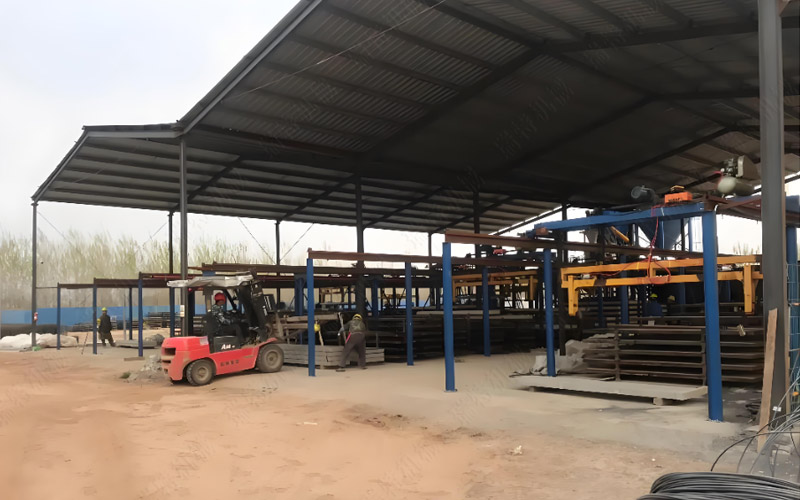
Against the backdrop of livestock farms moving toward intensified and standardized development, concrete slatted floors have become an important component of livestock housing infrastructure, with their market demand continuing to grow. Compared with traditional on-site manual operations, fully automatic concrete slatted floor production lines are gradually transforming the industry's production model. This article analyzes how fully automatic production lines achieve efficiency gains, drawing from actual production processes and capacity data.
Traditional concrete slatted floor manufacturing typically uses plastic molds combined with vibrating tables, with workers performing material distribution, compaction, troweling, and other steps one piece at a time. In this process, the concrete mix has a relatively high water content. After forming on the vibrating platform, the piece must rest in the mold until the next day before demolding. Due to moisture evaporation and variations in manual operations, the interior of the board may exhibit issues such as inadequate compaction and residual air bubbles.
In terms of production capacity, manual manufacturing is constrained by the number of molds available, curing space, and the speed of manual labor, resulting in limited daily output and significant quality fluctuations from one piece to another. For large-scale livestock projects requiring concentrated supply, traditional methods often struggle to meet delivery deadlines.
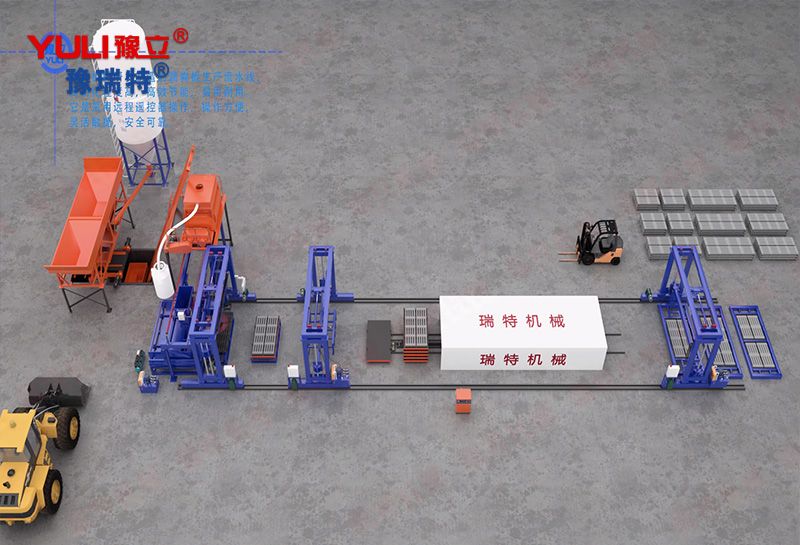
Fully automatic concrete slatted floor production lines integrate batching, mixing, material distribution, vibration forming, demolding, and stacking into a continuous flow operation. The production process is as follows:
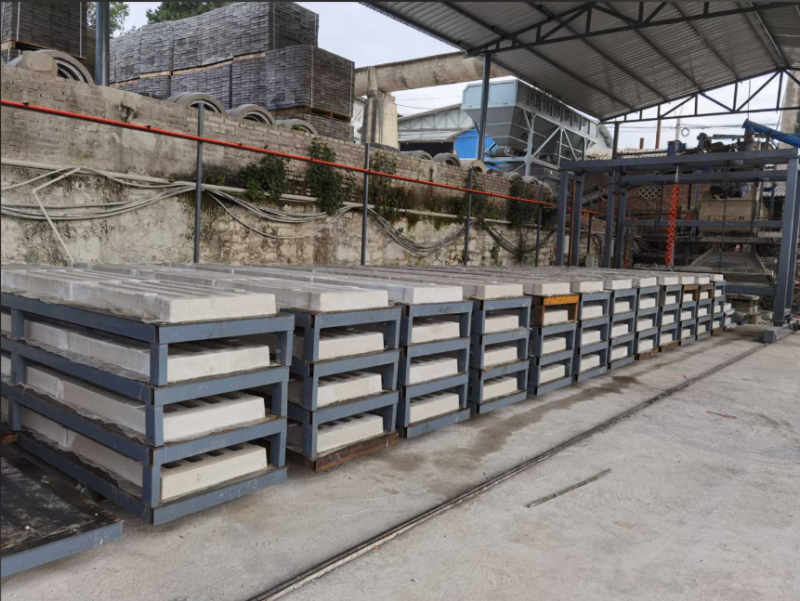
Raw materials are discharged from cement silos and aggregate bins, weighed by a metering scale according to the mix ratio, and then fed via a lifting hopper into a mixer where water is added and mixing begins. The mix enters a twin-shaft forced-action mixer for thorough mixing and is then transported via a belt conveyor to the distributor hopper. After secondary mixing in the distributor, the material is placed into molds and formed under high-pressure vibration. After manual surface finishing, an automatic turnover lifting device completes demolding onto pallets. The conveyor system moves the finished products to the stacking area, where a stacker arranges them before a forklift transports them to the curing zone.
Key capacity indicators:
| Parameter | Value |
|---|---|
| Working shift | 10 hours |
| Output per shift | 160–180 pieces (depending on board specifications) |
| Equivalent area | 200–400 m² per working day |
| Staffing | 5–6 personnel (including equipment monitoring and key process adjustments) |
| Automation level | Some systems allow single-operator computer control of the entire line |
Compared with manual manufacturing, a fully automatic production line can achieve dozens of times the output of manual methods in a single shift.
The efficiency advantages of fully automatic production lines are mainly reflected in the following areas:
(1) Shortened Curing Cycle
Traditional methods require the piece to remain in the mold until the next day before demolding, which slows mold turnover. Fully automatic production lines use three-dimensional curing kilns or tunnel-type curing kilns that automatically control temperature and humidity, enabling the concrete to reach demolding strength within approximately 24 hours and significantly improving mold turnover efficiency.
(2) Continuous Material Distribution and Vibration
Automated material distribution systems replace manual piece-by-piece filling operations. High-frequency vibration ensures thorough compaction and air bubble removal from the concrete. After forming, the piece can be demolded immediately and enter the curing phase, eliminating the need for extended mold occupancy.
(3) Mechanized Demolding and Stacking
Automatic turnover lifting devices and stacking systems replace manual handling and stacking. A single slatted floor piece together with its mold can weigh several hundred kilograms; mechanized operations effectively reduce labor demands and processing time.
In addition to capacity gains, fully automatic production lines offer advantages in product quality consistency. Machine-made concrete slatted floors are formed using high-frequency vibration, with a lower concrete mix water content. After high-frequency vibration, the aggregate and cement are densely bonded, air bubbles are effectively expelled, and the finished product has a compact internal structure. Compressive strength can reach C30–C40 grade, and surface smoothness is superior to that of handmade products.
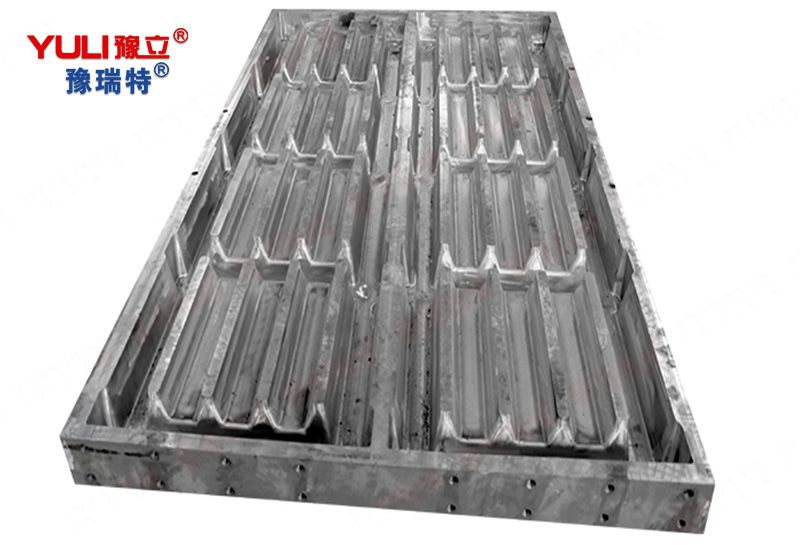
In contrast, handmade slatted floors—due to higher water content and limited vibration frequency—may contain internal voids, potentially affecting long-term durability. Additionally, machine-made products are formed in steel molds, providing higher dimensional consistency and facilitating precise installation in livestock houses.
Fully automatic concrete slatted floor production lines are suitable for production scenarios with stable order volumes and relatively uniform product specifications, particularly where concentrated supply for large-scale livestock projects is required. The initial equipment investment is relatively high, but the per-unit costs attributable to labor, mold wear, and rejection rates are all lower than those of manual manufacturing—and the larger the scale, the more pronounced the cost advantage.
For production needs involving diverse product specifications and smaller batch sizes, semi-automatic production lines or manual methods still retain their applicability in terms of flexibility. Customers can choose the appropriate production approach based on their order structure and financial position.
The core value of fully automatic concrete slatted floor production lines lies in replacing labor-intensive manual processes with continuous, standardized mechanical operations. By shortening the curing cycle, reducing labor dependence, and stabilizing product quality, a single production line can achieve dozens of times the output of traditional methods. For livestock farm developers and equipment manufacturers facing concentrated supply demands, this production approach offers a practical and viable path to improved efficiency.
For more information on specific equipment configurations or to request a customized capacity proposal, please feel free to contact us.
Notes for website publication:
Insert equipment photos: one panoramic view of the production line in Section II, and close-up shots of the curing kiln, distributor, and stacker in Section III.
Use the capacity table (already included in Section II) for quick reference.
Bold the subheadings such as "Shortened Curing Cycle," "Continuous Material Distribution and Vibration," and "Mechanized Demolding and Stacking" for visual emphasis.
Add a "Contact Us" button or inquiry link at the end of the article.
Suggested SEO page title: Fully Automatic Concrete Slatted Floor Production Line Capacity Analysis | [Company Name]
Let me know if you need a more concise version for an English brochure, a version with more technical specifications, or a U.S./European market-oriented adaptation.
CONTACT:Manager Li 13523220009
TEL:0373-7774868
ADDRESS:South of the middle section of Weiqi Road, Xinxiang Economic and Technological Development Zone
 Follow us
LINK:
Xinxiang Ruite Machinery Co., Ltd ICP:豫ICP备10026059号-2
13523220009
扫一扫 关注我们